
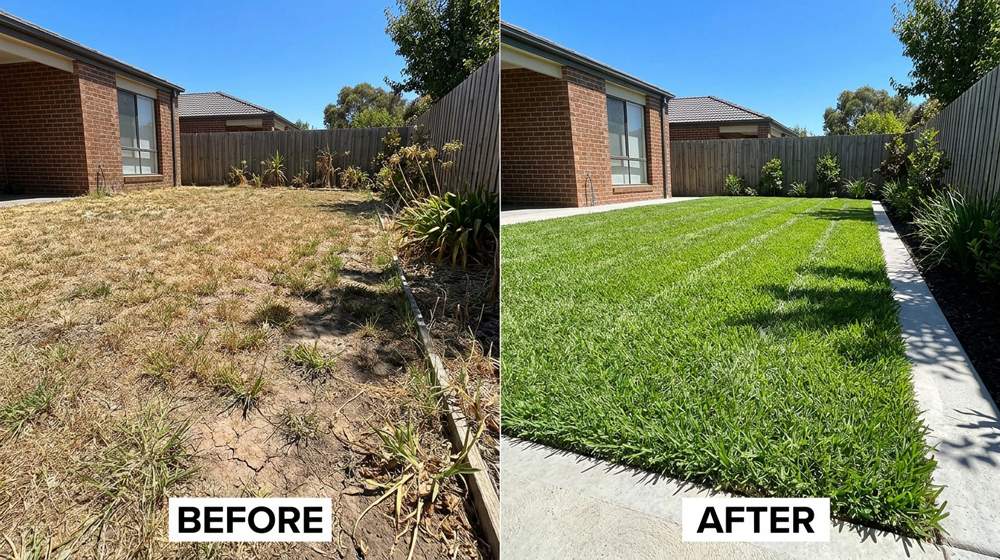
Every January and February, we receive the same calls from homeowners in Berwick, Narre Warren, Beaconsfield, Endeavour Hills, Hampton Park and surrounding suburbs:
“My lawn was beautiful in spring… now half of it is brown and crunchy!”
After caring for hundreds of lawns across Melbourne’s south-east every summer, we’ve identified the six most common reasons lawns turn brown — and the exact steps that bring 95% of them back to green and healthy within 2–3 weeks.
Is your lawn turning brown right now?
Send us a photo or call 0470 514 201 — we’ll diagnose it quickly and tell you exactly what to do.
1. Mowing Too Short (The #1 Cause We See)
Many people lower their mower blades in summer thinking it will “last longer”. In reality, cutting too short exposes the soil to extreme heat and stresses the grass severely.
Recommended summer heights:
- Sir Walter / Palmetto Buffalo → 60–80 mm
- Kikuyu → 50–70 mm
- TifTuf or Couch → 40–60 mm
Fix: Raise your mower height immediately.
2. Hydrophobic (Water-Repellent) Soil
Common in newer estates in Berwick Chase, Narre Warren North, Timbarra, and Cranbourne West. After weeks of heat, the soil repels water instead of absorbing it.
Fix: Apply a quality wetting agent (SaturAid, Lawn Soaker, or Debco Wet) this week and again every 6–8 weeks.
3. Shallow, Frequent Watering
Watering lightly every day keeps roots near the surface — the hottest and driest part of the soil.
Fix: Water deeply but less often — 25–35 mm, twice per week, before 8 am.
4. Lawn Grubs & Army Worms
Very common in newer estates in Berwick, Officer, Pakenham, and Narre Warren South. The grass looks like it’s dying from drought, but grubs are eating the roots from below.
Quick test: Tug gently on a brown patch. If it lifts like a carpet, it’s grubs.
Fix: Apply Acepryn or Yates Grub Kill immediately. Most lawns recover in 7–14 days.
5. Lack of Potassium & Heat Stress
Buffalo lawns especially need extra potassium during summer to withstand heat stress.
Fix: Apply a high-potassium summer fertiliser (Yates Buffalo PRO, Lawn Solutions Premium, or OxaFert Plus) in late November and early February.
6. Compacted Clay Soil & Poor Drainage
Older areas of Narre Warren, Hallam, and Endeavour Hills have heavy clay that becomes rock-hard in summer.
Fix: Core aeration + gypsum application in autumn significantly reduces this problem in future summers.
Summer Brown Lawn Rescue Checklist (Do This Now)
- Raise your mowing height today
- Apply a wetting agent this week
- Check for grubs and treat immediately if found
- Switch to deep watering twice a week
- Apply summer fertiliser if you haven’t since spring
Real Result – Timbarra, Berwick (January 2025)
One of our clients sent a photo showing over 60% brown Sir Walter Buffalo. We raised the height, applied wetting agent + Acepryn. Just 18 days later, the lawn was fully green again.
Frequently Asked Questions
How long does it take for a brown lawn to recover?
With the right treatment, most lawns show significant improvement in 7–14 days and full recovery in 3–4 weeks.
Is it too late to save my lawn in mid-summer?
Never too late. Even severely stressed lawns can recover well if you act quickly.
Should I fertilise a brown lawn?
Only after addressing watering and possible grub issues. Use a gentle, high-potassium summer fertiliser.
Need Help Saving Your Brown Lawn?
Send us a photo of your lawn or call 0470 514 201. We’ll give you a clear diagnosis and the fastest solution — whether you want to fix it yourself or have us take care of it.
Related Guides
- Lawn Mowing & Garden Care in Berwick
- Lawn Mowing & Garden Care in Narre Warren
- Summer Lawn Care Guide South East Melbourne
- Common Lawn Problems in South East Melbourne
Small Brother Lawn Mowing Service – Local experts who know exactly how to keep South East Melbourne lawns green even in the hottest summers.